

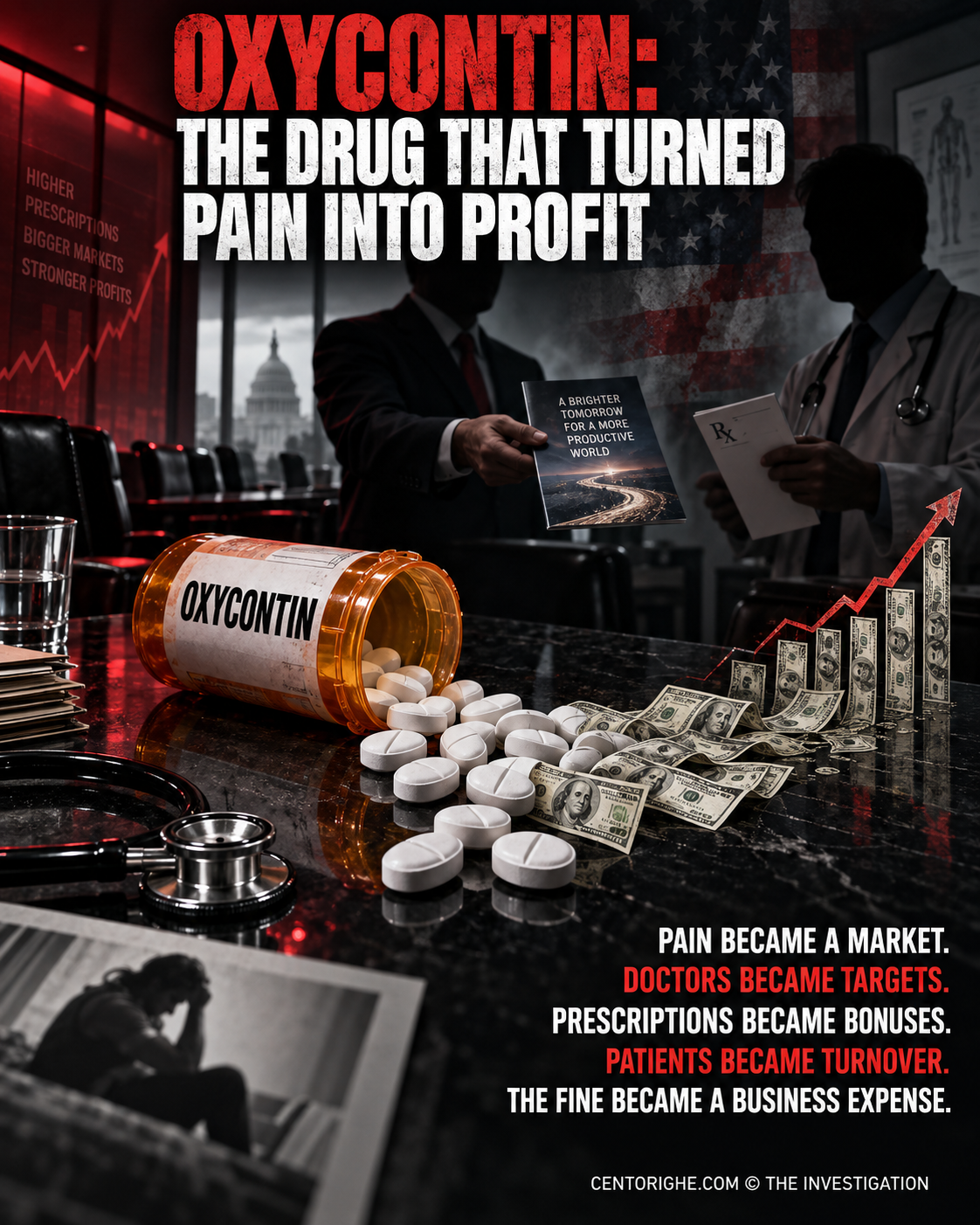
OxyContin: the drug that turned pain into profit. Purdue Pharma, the Sackler family, doctors turned into sales targets, reps rewarded according to prescription numbers, watchdogs turning up after the horse had already bolted.
OxyContin: The Drug That Turned Pain into Profit
Truth demands one correction before anything else: there is no evidence that millions of deaths can be attributed to OxyContin alone. The US Centers for Disease Control and Prevention recorded approximately 806,000 deaths from opioid overdoses between 1999 and 2023.
That figure includes prescription medicines, heroin, illicit fentanyl and deaths in which several substances may have been present at the same time. Yet OxyContin was, in effect, heroin in pill form, manufactured by Purdue Pharma.
The documented reality is terrifying: OxyContin was one of the driving forces behind the first wave of the crisis. It became the most recognisable face of a system capable of turning human suffering into an industrial goldmine.
The Promise Inside the Pill
OxyContin is extended-release oxycodone, a powerful opioid intended for severe pain. It was not an underground drug, and it has legitimate therapeutic uses. That very legitimacy made the sales machine even more effective, turning pharmaceutical reps and doctors into legalised drug pushers.
OxyContin: The Drug That Turned Pain into Profit
The Food and Drug Administration approved it in 1995. It reached the market the following year, sold on the promise that its gradual release would provide twelve hours of pain relief while reducing the potential for abuse.
The original label stated that its controlled-release properties were believed to lower that risk. At the same time, it warned that breaking, chewing or crushing the tablet could rapidly release a potentially toxic dose of oxycodone.
Treating pain was never the problem. The problem was widening the market, playing down the danger and pushing the product beyond the safest boundaries.
Purdue pushed OxyContin not only to oncologists and pain specialists, but also for non-cancer pain, arthritis, injuries and chronic conditions. GPs became a crucial target because they could dramatically expand the pool of potential patients.
American Journal of Public Health
The Prescription Army
The 2003 Government Accountability Office report contains figures that read like a military mobilisation. Purdue’s internal sales force grew from 318 available positions in 1996 to 671 in 2000.
With at least another 300 representatives supplied by Abbott Laboratories, the number of positions available for promoting OxyContin reached 971.
The list of doctors to be contacted grew from roughly 33,400–44,500 names to between 70,500 and 94,000. Each rep was expected to make about thirty-five sales calls every week.
The priority was to get in front of professionals who were already prescribing large quantities of opioids and to coax other doctors into expanding the market.
OxyContin: The Drug That Turned Pain into Profit
Then came the sweeteners. In 2001, the average annual salary of a Purdue representative was $55,000, while the average bonus reached $71,500. The largest bonus came within a whisker of $240,000.
Total bonuses estimated to be linked to OxyContin sales leapt from roughly $1 million in 1996 to $40 million in 2001.
Calling them mere “pharmaceutical representatives” therefore airbrushes the business end of the job. They were salespeople working to quotas, league tables, targets and incentives, with prescriptions written within their patches monitored closely.
There was no need to dream up smoke-filled back-room conspiracies. All it took was a system in which shifting more opioids meant taking home more cash.
The Memo
One 1996 sales memorandum bore the grotesque title: “It’s Bonus Time in the Neighborhood!”
Its message to the sales force was equally blunt: whoever sold the 40-milligram dose would win the battle. Pain became a competition. Dosage became a score. The patient vanished behind the sales chart.
University of Texas at Austin archives
Propaganda Dressed Up as Education
Purdue did not stop at calling on doctors’ surgeries. During OxyContin’s first five years on the market, it organised more than forty national conferences on pain management and speaker training, often in resort locations.
More than 5,000 doctors, pharmacists and nurses attended, with their travel, hotel rooms and meals all put on the company’s tab.
American Journal of Public Health
The company also put together a roster of nearly 2,500 doctors for its speakers’ bureau. It bankrolled more than 20,000 pain-related programmes between 1996 and July 2002.
It handed out starter-prescription vouchers, videos, fishing hats, cuddly toys, mugs, CDs and pens printed with tables for converting other analgesics into OxyContin.
OxyContin: The Drug That Turned Pain into Profit
One promotional video claimed that addiction to opioid painkillers affected fewer than one per cent of patients. According to the FDA, that claim was unsubstantiated.
They were not merely selling a pill. They were manufacturing a culture in which fearing opioids was made to look old-fashioned, while prescribing them was sold as modern, compassionate and scientific.
The machine worked. In both 2001 and 2002, annual sales broke the billion-dollar mark and prescriptions topped seven million. By 2001, OxyContin accounted for ninety per cent of Purdue’s pharmaceutical sales.
When one product keeps nearly the whole show on the road, every act of caution risks becoming a financial nuisance.
The Warnings Ignored and the First Conviction
Public reports of abuse and diversion into the illegal market began surfacing as early as 2000. In 2003, the FDA challenged Purdue over advertisements that played down the risks, left out relevant information and overstated the drug’s effectiveness.
The GAO report remained cautious. The data available at the time did not allow investigators to establish precisely the geographical relationship between availability, abuse and illegal diversion.
That statistical caution, however, did not make the already documented sales tactics disappear.
The Drug That Turned Pain into Profit
In 2007, Purdue Frederick, a Purdue subsidiary, pleaded guilty to falsely marketing OxyContin as less likely than other painkillers to cause addiction, abuse, diversion, tolerance and withdrawal.
The company and three executives paid approximately $634.5 million between them. Not one of those executives spent a day behind bars.
US Department of Justice records
A conviction should have smashed the model to pieces. It did not. The company carried on shifting opioids, while the fine took on the sinister appearance of an affordable cost of doing business within a colossal racket.
The Machine Gets Smarter
Documents from Purdue’s 2020 settlement with the Department of Justice reconstruct what happened next.
According to the government’s account attached to the settlement — and civil allegations should not all be treated as criminal admissions — Purdue used detailed data to identify exceptionally high-volume prescribers.
A tiny group, equal to just 1.5 per cent of doctors prescribing opioids, generated eighty per cent of OxyContin prescriptions.
Sales reps were sent after those professionals, rewarded when prescription numbers rose and placed on corrective performance plans when they missed their targets.
US Department of Justice records
OxyContin
In 2013, McKinsey was brought in for the next stage, tasked with “turbocharging” sales. The strategy targeted so-called high-value prescribers, including professionals whom prosecutors suspected of writing illegitimate prescriptions.
In 2024, the consultancy agreed to pay $650 million to settle the federal investigation. In 2025, former partner Martin Elling was handed a six-month prison sentence for destroying documents connected to that work.
Purdue pleaded guilty again in 2020, this time to three federal offences: one conspiracy to defraud the United States and two conspiracies involving unlawful kickbacks.
The company admitted misleading regulators about its safeguards against opioid diversion and paying illegal inducements to doctors in order to boost sales.
From Prescriptions to Fentanyl
America’s opioid epidemic does not have a single culprit and cannot be pinned on Purdue alone.
Other manufacturers, distributors, pharmacies, reckless prescribers, consultants, toothless watchdogs and institutions that failed to act in time all played their part.
Not every later death involving heroin or fentanyl can automatically be laid at OxyContin’s door.
The historical sequence nevertheless remains clear. According to the CDC, the first wave of deaths began with the rise in opioid prescribing during the 1990s. The second erupted with heroin from 2010 onwards. The third began in 2013 and was driven by illegally manufactured fentanyl.
OxyContin: The Drug That Turned Pain into Profit
The prescription pill was not the entire chain, but it helped open the first gateway into populations whose first encounter with an opioid had often come through legitimate medicine.
Justice Arrived After the Funeral
Purdue filed for bankruptcy in 2019. In 2024, the Supreme Court rejected an initial restructuring plan because it would have granted the Sackler family sweeping protection from civil claims, even though family members had not personally filed for bankruptcy.
A new $7.4 billion settlement was later approved, with $865 million earmarked for individual claims.
In April 2026, Purdue was sentenced to pay more than $5.5 billion in fines and forfeitures. Most of that sum will never actually be collected under the terms of the settlement. The Department of Justice will receive $225 million.
No member of the Sackler family was criminally charged in these proceedings.
Judge Madeline Cox Arleo told the victims without trying to dress it up:
“Your government has failed you.”
Since 1 May 2026, Purdue Has Ceased to Exist and Knoa Pharma Has Taken Its Place
On 1 May 2026, Purdue ceased operations and was replaced by Knoa Pharma, a non-profit organisation whose remit includes supplying medicines to treat addiction and reverse overdoses.
It is an almost perverse ending: the company that grew rich selling the opioid that came to symbolise the epidemic has been reborn with the declared mission of treating the wreckage left behind.
OxyContin lays bare the twisted face of American industry because it exposes a precise mechanism.
Research becomes a product. The doctor becomes a sales target. The rep becomes a prescription hunter. The patient becomes turnover. The penalty becomes a business expense.
OxyContin
The street dealer works on a corner and gets nicked.
The multinational walks into the consulting room wearing a badge and carrying a glossy publication, a conversion chart and a bonus pegged to sales.
The first figure is recognised immediately. The second has lawyers, consultants, friends in high places and decades in which to turn its responsibility into a financial settlement.
This scandal does not prove that every medicine is poison or that every doctor is complicit.
It proves something far more chilling: when profit controls clinical information, even medical care can be turned into a supply chain for addiction.
© centorighe.com — The Investigation